
Best Practices for Managing Business Expense Categories
Learn how to organise business expense categories, improve spending visibility, strengthen policy compliance, reduce errors, and simplify corporate travel reporting.


Business expense categories organise company spending into clear groups such as flights, accommodation, meals and transportation. A consistent categorisation system helps businesses track travel costs, enforce company policies, speed up reimbursements and improve financial reporting. Categories should be simple, clearly defined and reviewed regularly.
What is a Business Travel Expense Category?
Business expense categories are labels used to classify company spending. In corporate travel, each transaction is assigned to a category so finance teams can understand what was purchased, check policy compliance and report spending accurately.
For example, an airfare transaction may be classified under “Flights”, while an airport taxi may fall under “Ground Transportation”.
You May Also Like: How Corporate Travel and Expense Management Software Works
What Are the Benefits of Expense Categorisation?
Accurate expense categorisation gives companies a clearer view of where their corporate travel budget is going.
Its main benefits include:
- Better spending visibility: See how much the company spends on flights, hotels, meals and transportation.
- Stronger budget control: Compare category-level costs with approved travel budgets.
- Improved policy compliance: Identify restricted, excessive or out-of-policy expenses.
- Faster reimbursements: Reduce corrections and follow-ups between employees and finance teams.
- Accurate reporting: Maintain consistent accounting records and audit trails.
- Smarter cost-saving decisions: Identify categories where costs or usage are increasing.
- Fewer expense errors: Help employees select the correct category when submitting claims.
What Are the Common Corporate Travel Expense Categories?
The exact categories may vary depending on the company’s travel policy and reporting requirements. However, most corporate travel programmes include the following:
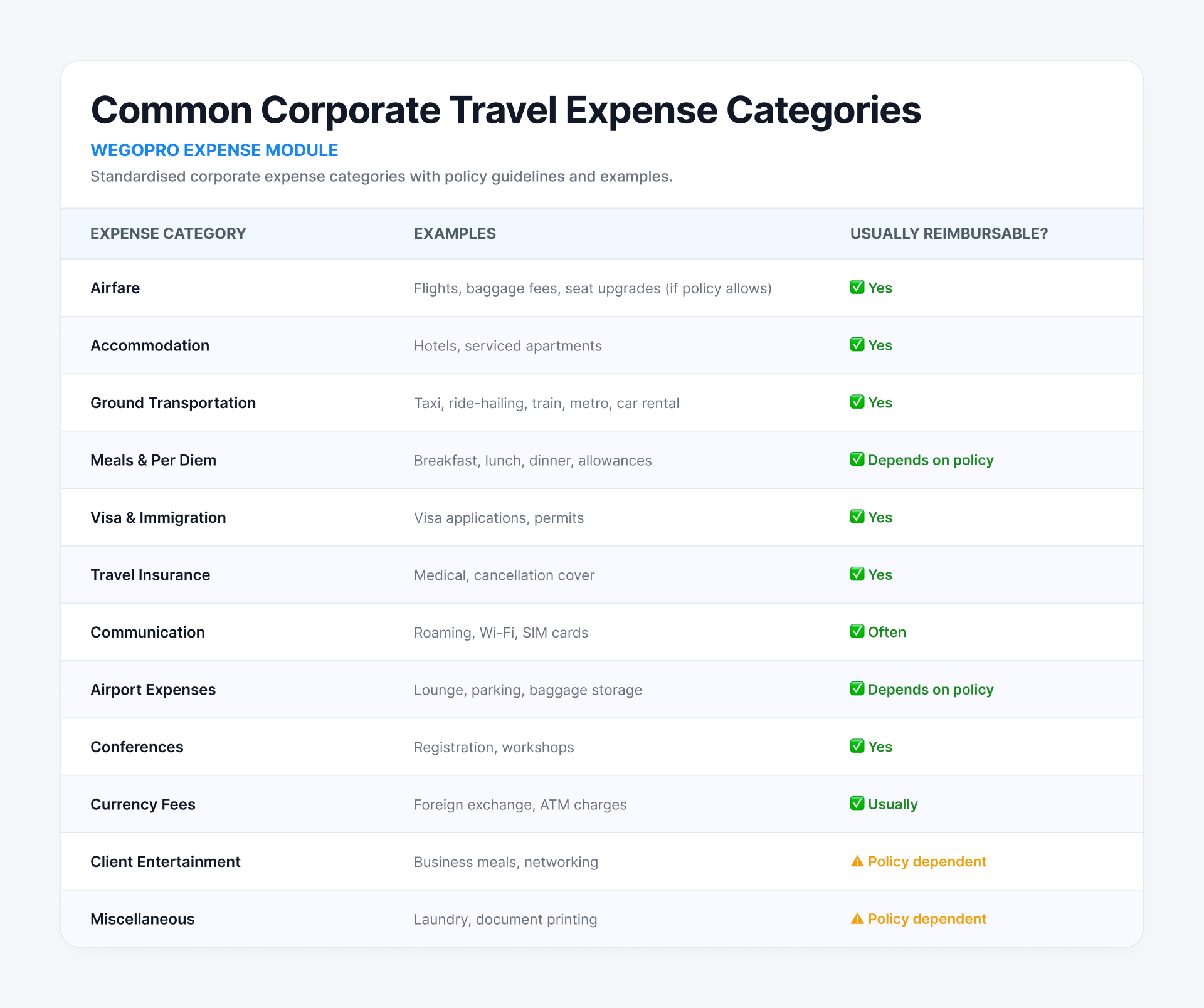
Companies may create subcategories when they need more detailed reporting.
What Are the Best Practices for Managing Business Expense Categories?
Managing business expense categories effectively requires clear definitions, consistent processes, and regular reviews.
1. Keep Expense Categories Simple
Use a limited number of clearly named categories. Employees should be able to choose the correct option without asking the finance team for help.
Avoid creating separate categories for every small expense unless the additional detail is necessary for reporting.
2. Define What Each Category Includes
Add a short description and relevant examples for every expense category.
For instance, clarify whether airport parking should be recorded under ground transportation, travel ancillaries or another category. Clear definitions reduce incorrect submissions.
3. Align Categories With Company Policy
Expense categories should reflect the company’s travel and expense policy.
Connect each category with its relevant:
- Spending limits
- Receipt requirements
- Approval rules
- Reimbursement conditions
- Required supporting information
Client entertainment expenses, for example, may require attendee names and a clear business purpose.
4. Separate Business and Personal Expenses
Clearly explain which costs are reimbursable and which are personal.
Employees should also split transactions when a single payment contains both business and personal expenses. This prevents personal costs from being included in company reports.
5. Standardise Categories Across the Business
Use the same expense category names across departments, offices and employee groups.
One department should not use “Taxi Expenses” while another uses “Local Travel” for the same transaction type. Standardisation makes company-wide reporting more reliable.
6. Automate Receipt Capture and Categorisation
Expense management software can read receipt information, match transactions and recommend suitable categories.
Automation reduces manual data entry, improves accuracy and helps finance teams process expense reports more efficiently.
7. Review Category-Level Spending Regularly
Finance and travel managers should analyse expense category reports monthly or quarterly.
Look for:
- Increasing hotel or flight costs
- Duplicate claims
- Frequent policy exceptions
- Unusually high meal expenses
- Excessive use of miscellaneous categories
- Repeated out-of-policy transactions
These insights can help businesses update budgets, negotiate better rates and strengthen expense policies.
8. Update Categories When Business Needs Change
Review the category list whenever the company introduces new travel services, payment methods, office locations or policy rules.
Remove categories that are no longer used and clarify categories that regularly cause submission errors.
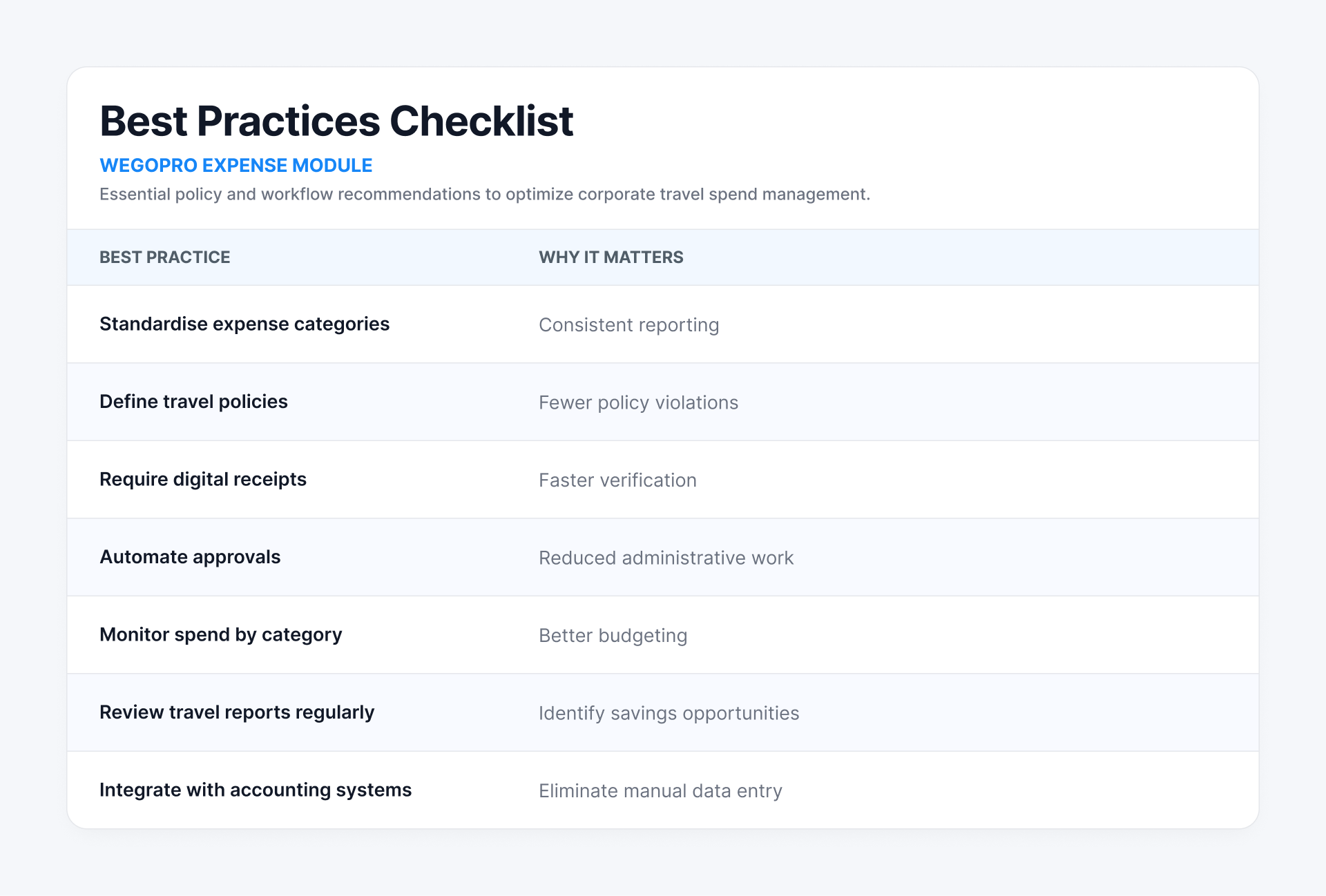
Business Expense Categorisation Checklist
Use this checklist when creating or reviewing your company’s expense categories:
How Does Expense Management Software Improve Categorisation?
Expense management software captures receipts, matches transactions and recommends the most suitable expense category. It can also apply company policies, identify possible duplicate claims and generate category-level spending reports.
An integrated travel and expense management platform such as WegoPro connects travel bookings, approvals and expenses, giving businesses better visibility and control throughout the corporate travel process.
Frequently Asked Questions About Business Expense Categories
How many business expense categories should a company have?
There is no fixed number. Companies should use enough categories to support useful reporting without making expense submission difficult for employees.
What is the difference between an expense category and a cost centre?
An expense category shows what the money was spent on. A cost centre identifies the department, team or business unit responsible for the spending.
How should miscellaneous travel expenses be managed?
Use the miscellaneous category only when no suitable category exists. Employees should provide a description, and finance teams should review these transactions regularly.
Who should manage business expense categories?
Finance usually owns the category structure, with input from travel managers, HR teams, accounting teams and department leaders.
What happens when an employee chooses the wrong expense category?
The expense report may require correction, additional review or reapproval. Automated expense tools can reduce errors by recommending categories based on receipt and transaction information.
Should different departments have different expense categories?
Core categories should remain consistent across the business. Department-specific subcategories may be added when they support meaningful budgeting, reporting or approval requirements.
Why should companies monitor miscellaneous expense categories?
Frequent use of miscellaneous categories may indicate unclear category definitions, missing categories or incorrect submissions. Regular monitoring helps businesses maintain accurate expense data.