
Business Travel Compliance: Everything Companies Need to Know
Learn how business travel compliance helps companies reduce risk, control costs, improve policy adherence, and keep employees safe while travelling.

Corporate travel helps businesses meet customers, close deals, attend events, and expand into new markets. However, every business trip also comes with important responsibilities.
Employees must follow company travel policies, finance teams need accurate expense records, and HR teams must fulfil their duty of care obligations. A strong business travel compliance framework brings these responsibilities together by ensuring that every trip follows company policies, financial procedures, and relevant legal requirements.
Without proper compliance, businesses may face higher costs, policy violations, tax penalties, employee safety risks, and limited visibility into travel spending.
This guide explains what business travel compliance means, why it matters, the common challenges companies face, and how better processes and technology can help improve compliance.
You may also like: Business Travel Approval Workflow: A Step-by-Step Guide
What is Business Travel Compliance?
Travel policy compliance refers to how consistently employees follow their organisation’s travel rules when requesting, booking, approving, and claiming expenses for business trips. It is usually calculated as a percentage by dividing the number of compliant bookings by the total number of bookings within a specific period.
A corporate travel policy defines how employees should arrange trips, permitted spending limits, approved suppliers, and required authorisation steps. Compliance shows whether actual travel decisions align with these guidelines. Strong compliance helps businesses benefit from negotiated rates, maintain accurate audit records, and meet their duty of care responsibilities. Poor compliance can increase costs, limit traveller visibility during emergencies, and create additional administrative work for finance teams.
Travel policy compliance is broader than a single percentage. Organisations commonly monitor four areas: whether employees use the approved booking platform, choose preferred suppliers, follow cabin class and accommodation rate limits, and book within the required advance period, such as at least 14 days before a domestic flight.
It ensures that every business trip is:
- Approved before travel
- Booked according to company policy
- Legally compliant
- Safe for employees
- Properly documented
- Correctly reported and reimbursed
Why is Business Travel Compliance Important?
Compliance isn't just about following rules. It protects both the company and its employees.
Good travel compliance helps organisations:
- Control travel costs
- Improve travel policy compliance
- Reduce fraud and expense misuse
- Meet tax and immigration requirements
- Protect travelling employees
- Simplify audits
- Gain better visibility into travel spend
What Does Business Travel Compliance Cover?
Business travel compliance involves several essential components that work together to keep travel organised, compliant, and cost-effective.
- Travel policy to guide employee bookings and travel decisions.
- Pre-trip approvals to authorise travel before expenses are incurred.
- Budget compliance to keep travel spending within approved limits.
- Expense compliance to ensure accurate expense claims and reimbursements.
- Tax compliance to meet applicable tax laws and reporting requirements.
- Immigration compliance to manage visas, work permits, and travel documentation.
- Duty of care to protect employee health, safety, and wellbeing during travel.
- Reporting and audits to maintain accurate records and monitor policy compliance.
Common Business Travel Compliance Challenges
Many companies already have travel policies. The real challenge is getting employees to follow them consistently.
Some common problems include:
1. Out-of-Policy Bookings
Employees often book flights or hotels outside approved channels because they find cheaper prices elsewhere or want more flexibility.
These bookings reduce visibility and make spending difficult to control.
2. Manual Approval Processes
Approvals through emails, phone calls, or spreadsheets often create delays.
Employees wait longer to book, leading to higher travel costs and inconsistent policy enforcement.
3. Missing Expense Documentation
Lost receipts, incomplete expense claims, and manual reporting make reimbursement slower and increase the risk of inaccurate financial records.
Also Read: The Real Cost of Delayed Expense Reimbursements (And How to Fix It)
4. Limited Visibility
Finance teams cannot effectively manage travel spend when bookings happen across multiple websites, travel agencies, and personal credit cards.
5. Changing Regulations
International travel regulations constantly evolve.
Visa requirements, work permits, tax rules, and immigration policies differ across countries, making compliance increasingly complex for global businesses.
Key Elements of a Strong Business Travel Compliance Programme
Businesses can strengthen travel compliance by putting the following elements in place:
1. A Clear Travel Policy
Every organisation should have a documented travel policy that explains:
- Booking procedures
- Approved travel providers
- Flight and hotel limits
- Expense rules
- Approval process
- Reimbursement timelines
- Travel insurance
- Emergency contacts
2. Automated Pre-Trip Approvals
Approvals should happen before bookings are made.
Automated workflows ensure requests are routed to the correct approvers based on department, budget, destination, or employee level.
It reduces delays while improving policy compliance.
3. Policy-Compliant Booking
Employees should book through a central platform where company travel policies are automatically applied.
For example:
- Flights within budget
- Preferred airlines
- Approved hotels
- Cabin class restrictions
- Spending limits
4. Expense Compliance
Employees should submit expenses quickly with supporting receipts.
Modern expense systems automatically:
- Capture receipt data
- Match expenses to policies
- Flag exceptions
- Simplify approvals
5. Duty of Care
Companies have a responsibility to support employees while they travel.
It includes:
- Knowing where employees are travelling
- Monitoring travel disruptions
- Providing emergency assistance
- Maintaining traveller communication
6. Compliance Reporting
Regular reporting helps organisations monitor:
- Policy compliance rate
- Out-of-policy bookings
- Travel spend
- Approval turnaround time
- Reimbursement delays
- Exception requests
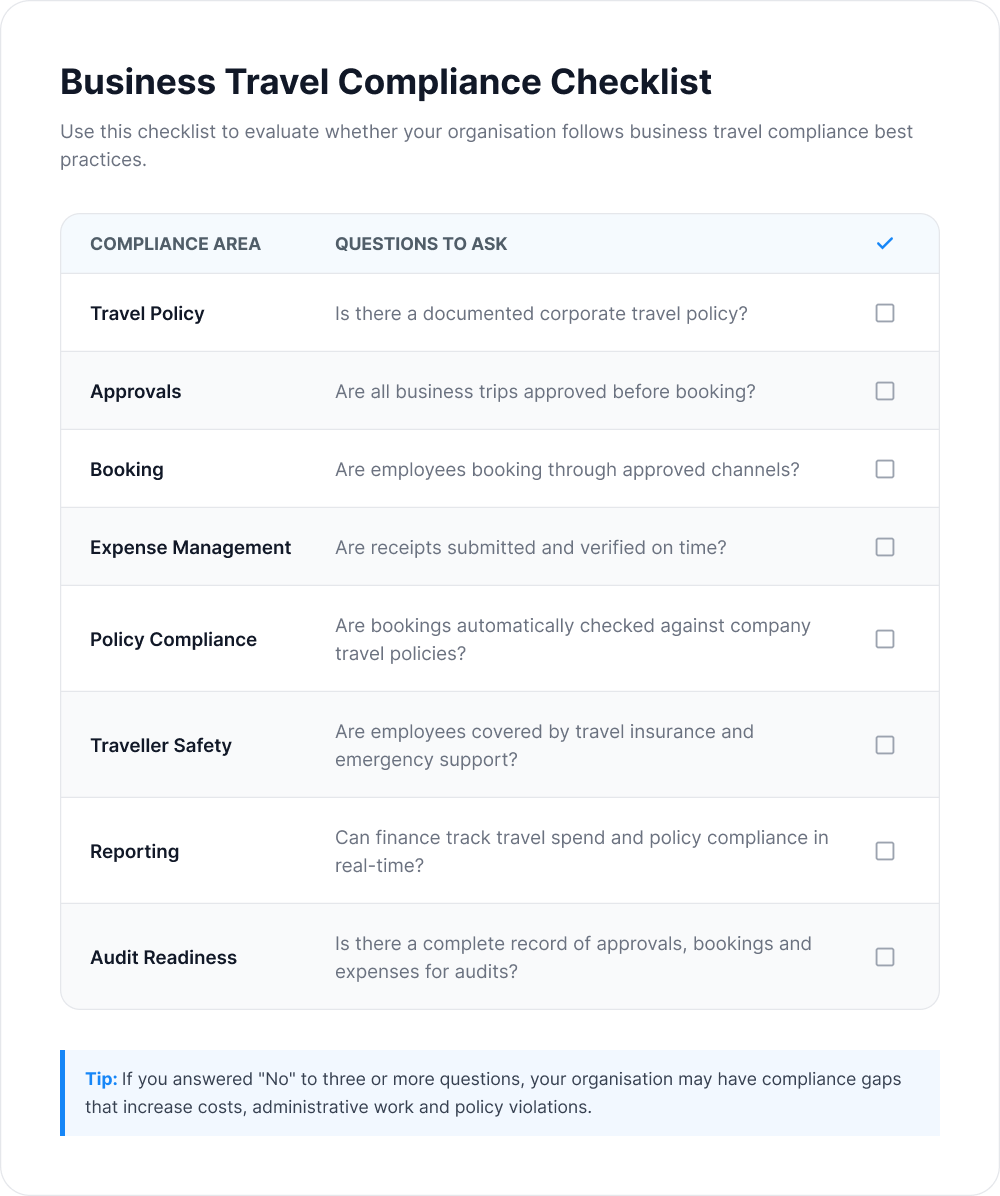
Business Travel Compliance Checklist
A simple checklist can help you identify gaps in your current travel programme.
Review the questions below to see how well your organisation is managing business travel compliance.
How WegoPro Helps Businesses Stay Compliant
Managing compliance manually becomes increasingly difficult as businesses grow.
WegoPro simplifies business travel compliance by bringing travel booking, approvals, policy controls, expense management, and reporting together in one platform.
With WegoPro, businesses can:
- Automate travel approval workflows
- Apply travel policies during booking
- Centralise flights, hotels, and expenses
- Track travel spend in real time
- Improve policy compliance
- Simplify expense reporting
- Provide better visibility for finance teams
- Support traveller safety through a single travel management platform
By replacing emails, spreadsheets, and manual reviews with a centralised platform, businesses can simplify compliance management and provide employees with a smoother travel experience.
Business Travel Compliance: Frequently Asked Questions
Does Business Travel Compliance Apply to Domestic Trips?
Yes. Domestic trips must also follow company booking, approval, expense, tax, safety, and documentation requirements.
Who Is Responsible for Business Travel Compliance?
Compliance is a shared responsibility involving employees, travel managers, finance teams, HR, approvers, and company leadership.
How Should Companies Handle Travel Policy Exceptions?
Employees should provide a valid reason, supporting details, and obtain approval before making an out-of-policy booking or expense.
What Travel Records Should Companies Keep for Audits?
Companies should retain booking confirmations, approvals, invoices, receipts, expense reports, visa documents, and records of policy exceptions.